By 2030, self-driving technology will be commercially viable in specific, constrained use cases—but far from the fully autonomous, ubiquitous reality once promised. This post explores what the state of autonomous vehicles will actually look like by 2030, based on current data, market forecasts, and technological progress.
Executive Summary: The Real State of Self-Driving by 2030
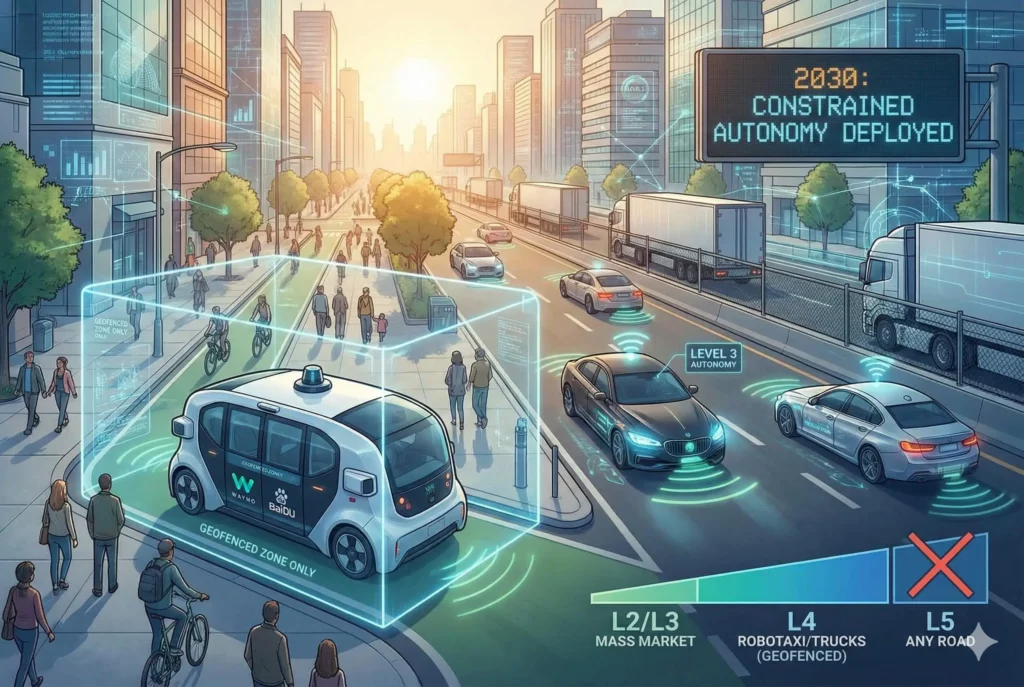
By 2030, autonomous vehicles will be standard, but they will still be constrained. Geofenced robotaxi services will operate profitably in significant cities, Level 3 highway automation will be mainstream in premium cars, and autonomous trucking will run on specific logistics corridors. However, whole Level 5 autonomy—cars that can drive anywhere, anytime, under any conditions without human supervision—will still not be achieved at scale. Instead of a total revolution, 2030 will mark the end of a decade of consolidation and commercialization: real services, real revenue, but limited domains.Current State of Autonomous Vehicles (2024–2025)
From Level 2 to Level 4: Where We Really Are Today
Most automation on the road today is Level 2 driver assistance—systems like Tesla Autopilot, GM Super Cruise, and similar offerings that can steer, accelerate, and brake but still require constant driver supervision. These semi-autonomous systems dominate the current market and account for the majority of “self-driving” features drivers actually experience. Level 3 and Level 4 systems—where the car can handle all aspects of driving within specific conditions or areas—are still in the early stages of rollout, primarily through limited robotaxi deployments and tightly controlled feature sets in premium cars.Robotaxis: From Pilot Programs to Real Services
Companies like Waymo and Baidu Apollo have transitioned from small pilots to meaningful commercial operations in select cities. Waymo is operating driverless ride-hailing services in cities such as Phoenix, San Francisco, Los Angeles, and Austin, handling hundreds of thousands of rides per week. Baidu’s Apollo Go has completed millions of robotaxi rides in multiple Chinese cities and is expanding internationally. These deployments demonstrate that Level 4 urban autonomy is technically achievable and commercially viable, as long as it’s geofenced to well-mapped, highly tested urban service areas with favorable weather and regulatory conditions.Tesla FSD: Powerful Driver Assistance, Not Full Autonomy
Tesla’s Full Self-Driving (FSD) remains an advanced driver-assistance system rather than a truly autonomous solution. With hundreds of thousands of beta users, FSD can handle many everyday driving situations, but still:- Requires constant driver supervision
- Struggles with complex edge cases like construction zones and unprotected left turns
- It is heavily limited by its vision-only sensor approach (no LiDAR or radar)
Where Self-Driving Will Succeed by 2030
1. Urban Robotaxis in Major Cities
By 2030, urban robotaxi services will be the most visible and mature form of self-driving. Think of this as “self-driving as a service,” not something you own in your driveway. Projections suggest that:- Robotaxi fleets are expected to grow from a few thousand vehicles today to tens of thousands globally by 2030.
- They will operate in a limited number of Tier 1 cities with supportive regulations and infrastructure.
- Unit economics will surpass or match those of human-driven ride-hailing in those cities, especially as hardware costs decline and utilization increases.
2. Level 3 Highway Autonomy Becomes Common
Level 3 autonomous features—where the car can drive itself on the highway under certain conditions while the driver can temporarily divert attention—are already appearing in premium vehicles in Europe and Asia. By 2030:- Premium brands (Mercedes-Benz, BMW, Audi, etc.) will ship Level 3 systems widely as standard or optional features.
- Highway-only autonomous driving in traffic jams or at moderate speeds will become the norm for high-end vehicles.
- Some mass-market brands will follow, especially in Europe and parts of Asia.
3. Autonomous Trucking on Fixed Corridors
Autonomous trucking is another area where self-driving will become practical—but not universal—by 2030. Rather than replacing all truck drivers, autonomy will:- Focus on fixed highway corridors between logistics hubs.
- Operate on mostly predictable long-haul routes in favorable weather regions.
- Use transfer hubs where human drivers handle complex urban segments at the beginning and end of each route.
Why We Still Won’t Have Full Level 5 Autonomy by 2030
1. Edge Cases Remain the Hard Problem
Most of the progress in self-driving has been in handling common driving scenarios. The remaining challenge is the long tail of edge cases:- Complex construction zones
- Unpredictable pedestrians and cyclists
- Unstructured rural roads
- Emergency vehicles, temporary lane changes, and unusual obstacles
2. Weather and Environmental Limits
Self-driving cars still perform poorly in:- Heavy rain and snow
- Fog and low-visibility conditions
- Poorly marked or damaged roads
3. Cybersecurity and Safety Certification
As vehicles become more connected and more autonomous, they also become more vulnerable:- Potential attacks on sensors (spoofing, jamming)
- Compromised over-the-air update systems
- Malicious V2X (vehicle-to-everything) messages
Regulation: Enabler and Bottleneck
Fragmented Landscape in the US
The United States has no unified federal AV framework; instead, states are leading the charge:- Arizona and parts of Texas are highly AV-friendly, allowing for extensive testing and commercial deployments of robotaxis and trucks.
- California permits robotaxi operations, but with tighter controls and evolving regulatory battles.
- Other states are either hesitant or still designing their own rules.
Europe and Asia: Structured but Cautious
Europe is moving forward with more structured regulation around:- Level 3 highway autonomy (e.g., Automated Lane Keeping Systems)
- Clear liability frameworks allocating responsibility between drivers and manufacturers
- Strict safety standards (e.g., ISO 26262 functional safety)
Winners and Losers in the 2030 Self-Driving Landscape
Waymo: Operational Lead in Geofenced Autonomy
Waymo’s disciplined focus on geofenced Level 4 robotaxis gives it a strong operational lead:- Millions of fully driverless rides completed in real cities
- Multi-sensor fusion (cameras, LiDAR, radar) for high redundancy
- Regulatory goodwill earned through careful deployment and safety reporting
Tesla: Dominant in Assisted Driving, Unproven in True Autonomy
Tesla will likely remain:- A leader in Level 2+/Level 3 driver-assistance, thanks to its massive fleet and data advantage.
- Highly visible in the public conversation, but behind in fully driverless, geofenced services compared to companies like Waymo and Baidu.
Baidu Apollo and Regional Leaders
Baidu’s Apollo Go is already a major force in China and is expanding into new regions through partnerships and direct operations. By 2030, it is likely to be one of the largest robotaxi operators globally, particularly in Asia and the Middle East.Traditional Automakers: Quiet but Important
Legacy automakers may not dominate robotaxis, but they will:- Ship tens of millions of vehicles with Level 2 and Level 3 features.
- Partner with tech companies (e.g., Mobileye, Nvidia, AV software providers) to offer semi-autonomous capabilities as standard safety and comfort features.
What Self-Driving Will Not Achieve by 2030
To set realistic expectations, it’s important to be clear about what won’t happen by 2030:- No widespread Level 5 autonomy (drive anywhere, anytime, in all conditions).
- There will be no mass adoption of fully autonomous private cars that you can buy and use everywhere.
- There will be no complete replacement of truck drivers—autonomy will be corridor-based and hybrid, rather than universal.
- No 90% reduction in global traffic fatalities purely from AVs—penetration will still be too low for that scale of impact.
Conclusion: A Decade of Real Progress, Not Sci-Fi
By 2030, self-driving technology will be:- Visible in many major cities through robotaxi services.
- Common on highways through Level 3 features in premium vehicles.
- Strategically deployed in logistics via autonomous trucking corridors.
- Proved itself in narrow, high-value domains
- Found economically viable business models
- Laid the groundwork for the deeper transformations that may arrive in the 2030s and 2040s
References and Sources
This article draws on the latest research, market reports, and operational data from leading autonomous vehicle companies and industry analysts. Below is the complete list of sources cited:- Scribd – The State of Self-Driving Technology by 2030
- Qatar University – Autonomous Vehicle Technology Thesis
- SSRN – The State of Self-Driving Technology by 2030
- Politecnico di Torino – Development of Autonomous Driving in Electric Vehicles
- ETH Zurich – Recent Perspectives on the Impact of Autonomous Vehicles
- Research and Markets – Autonomous Vehicle Global Market Report 2025
- ITS International – Level 4/5 Autonomous Driving Timeline
- Sandicliffe – Regulatory Hurdles for Autonomous Tech in the UK
- King’s College London – Autonomous Self-Driving Vehicles and Legal Framework
- Precedence Research – Autonomous Vehicle Market Size to Hit USD 5439.46 Billion by 2035
- Diana Wolf Torres – Tesla’s Full Self-Driving Analysis
- Heartspace AI – Waymo Robotaxi Expansion to New Cities in 2025
- Solution1 – Comprehensive Review of Autonomous-Vehicle Industry 2025
- Reddit – Tesla Full Self-Driving Development Discussion
- Edge Case Research – ISO 26262 Safety Standards for Autonomous Vehicles
- HDI Research – Robotaxi Market: Autonomous Ride-Hailing Economics
- Auto2x – Level 3 Automation in European Vehicles by 2025
- Autonomous Vehicle International – ISO 26262 Road Vehicle Functional Safety
- NIH/PubMed Central – Quantifying the Impact of Autonomous Vehicle Deployments
- Reddit – Geofenced Robotaxi Release Timeline Estimates
- InsZone Insurance – Impact of Autonomous Vehicles on Auto Insurance in 2025
- PatentPC – The Future of Autonomous Vehicles: Market Predictions for 2030
- Horizon Connect – How 5G V2X Are Driving Smart Mobility in 2025
- Akridata – Edge Case Detection and AI Safety in Autonomous Vehicles
- MIT Robotics – Autonomous Vehicles Driving in Snow
- ABI Research – 5G as Unifying Connectivity Technology for Future Cars
- Goldman Sachs – Autonomous Vehicle Market Forecast and Ridesharing Growth
- Fast Company – Waymo: Leading the Robotaxi Revolution (Most Innovative Companies 2025)
- Freight Amigo – Self-Driving Trucks and Transportation Industry Impact 2025
- Data Mint Intelligence – Autonomous Vehicle Market Growth, Trends & Forecast 2030
- VicOne – 2025 Automotive Cybersecurity Report
- Kr Asia – The Moral Dilemmas Behind Developing Self-Driving Vehicles
- Inside China Auto – Baidu Partners With Uber To Deploy Apollo Go Robotaxis Globally
- CYEQT – Autonomous Driving vs. Cybersecurity Challenges